Showing posts with label figurative. Show all posts

Tuesday, 13 August 2013

Studio Clearout

Some older portraiture studies done in the studio over the past year, prior to moving out over the summer.The next few posts after these will mainly be newer landscape work, waiting for paint to dry on the landscape panels!


Drawing study of my younger brother, preparatory work for a future painting project.


Study of Leyne


Small poster study of my youngest brother- this study was done quite a while ago, almost 2 years ago


Tania, first state


Vivi, first state

Tuesday, 6 August 2013

Gordon Museum Sketches, Part II


A bit on the side regarding Joseph Towne and the nature of his works shown in the Gordon Museum, together with the final sets of drawing studies:


Joseph Towne (1806-1879) was an English moulageur and sculptor who spent the majority of his professional career attached to Guy’s Hospital. Talented from an early age, he showcased works in the Royal Academy shows, but the majority of his career was spent working with several key figures in Guy's Hospital in London. His total output was estimated to be more than 600 models- the bulk of it were dermatology sculptures- with nearly a hundred out that the total amount being anatomical and pathology/comparative models. He is, however chiefly known for his anatomy ceroplastics (coloured wax models, the ones from which the studies were done).


Distinctions in Towne’s work in comparison with other contemporary anatomical models are that ‘…European models (tend to be) models of the living…’ (Towne’s models) as ‘…models of dead people… Towne modeled what he saw’. (Edwards, W. 2013). Roberta Ballestriero, a researcher specializing in wax anatomical models noted the main contrast between Italian and English/German treatment of anatomical waxes relate to stylization vs. anatomical realism. The models in the Cagliari collection were ‘Anatomical Venuses’ compared to the stark, brutal realist depiction of a dissected corpse as per Towne’s treatment. The Cagliari models made by Susini were influenced by a neoclassical tradition, comparable to that (as observed by Ballestriero) of Canova’s statues. However, it can be noted as well how they seem to use the ‘venus’ classification to depict a sensualised figure…


Whilst the Towne models tend to have minimum adornment, being depicted mainly for its intended purpose (as teaching models).

Regardless of treatment, they were all masterful depictions of anatomical figures, and perhaps more importantly as well, the rare instances where overlaps in works designed for a didactic purpose transcend and assume an aesthetic quality unique to the circumstances of its production.


References:

Ballestriero, R. (2010) Anatomical Models and Wax Venuses: Art Masterpieces or Scientific Craft Works? Journal Compilation, Anatomical Society of Great Britain and Ireland. Vol. 216, pp223-234.

Edwards, W.G.J. (2013) Interview with the curator. London, 14 March. [William Edwards is the curator of the Gordon Museum of Pathology in King’s College London].

Riva, A. (2007) Flesh & Wax: The Clemenete Susini’s Anatomical Models in the University of Cagliari. University of Cagliari: Ilisso.

Sunday, 14 July 2013

Gordon Museum Sketches, Part I

As mentioned in the previous post, here are the working sketches for the Gordon Museum project for my coursework.


On-and-off over the past 10 months, I have been based in/working at the Gordon Museum of Pathology in Guy’s Hospital near London Bridge, as part of my coursework. There, I started some research into the ceroplastic sculpts of Joseph Towne (1806-1079), an English moulageur and sculptor. There were a series of wax anatomical models of his (amongst other things you’d expect in a pathology museum) based in one of the rooms which were used as a starting point for creating work. Thus, these here sketches of the ceroplastic models of Towne.


They took a pretty long time to get reasonably correct, even in the basic preliminary contour/line drawing stage. And with the added caveat that we cannot take photos meant having to schedule the time to be in working from the display cases made the project pretty slow-going. In the end though, they turned out pretty nicely, with some of the sketches being turned into photoetches and intaglio prints.

Part two of this post continues with the last few sets of sketches (large double page drawings).

Tuesday, 29 January 2013

Sketchbook drawings and paintings, round 3


A bit of painting & drawing studies for the new year!

Several poster studies from a while back & Boldini/Velazquez study

Saturday, 17 November 2012

Sketchbook Drawings and Paintings, Round 2


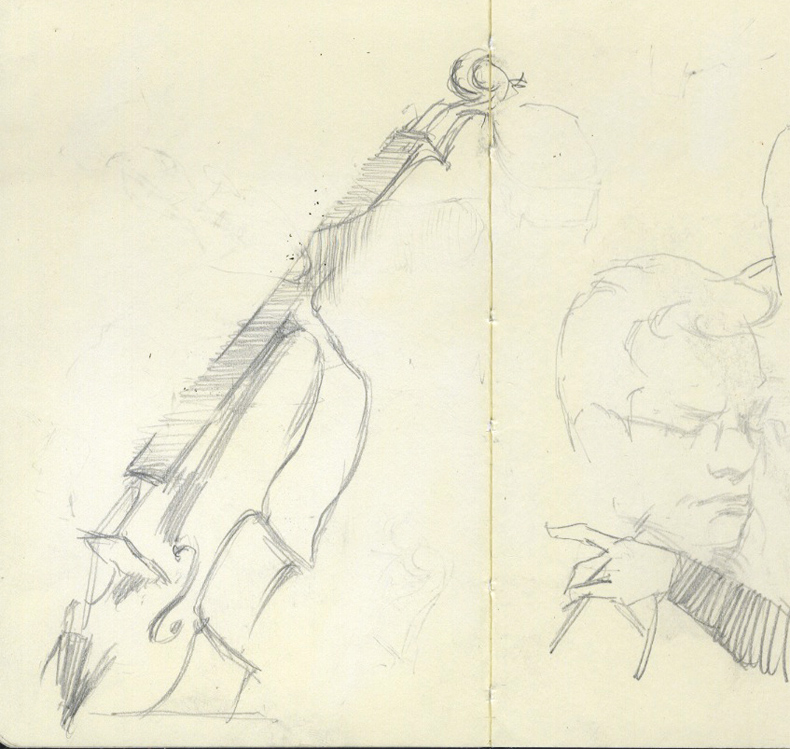
More sketches and figure drawings. Trying out certain approaches towards construction in figure drawing, i.e. 'less blocky', going for identifying sweeping, gestural statements and then narrowing down to key anatomical aspects. Some orchestral sketches to add to the mix as well.


Finished charcoal drawing for the painting re-try.


Thursday, 23 August 2012

Poster Studies


A 'poster study', or a quick, small-scale mass sketch is helpful to solve issues in getting the visual impression from a particular composition, scene, pose, etc. It's meant to be the broadest and simplest possible expression of what you see, but also must contain some basic information that you could use in aid of the actual work itself. 

Time taken ideally for a poster study or sketch? Depends, really on what you want to achieve. Most of these were done in various drop-in evening classes, sketching sessions, life drawing sessions, from photographs, etc etc etc. usually when working in mass is more preferable than linework. They usually stop short at the 'block-in' stage, right before attempting to correct/amend drawing and considering edges. It's quite fun doing poster studies, and a goal once set by a tutor was to attempt 50 successful poster studies in the course of a single year to force yourself to think in much broader, simpler terms in mass expression. 


Procedure was like zapping solid blocks of mass in place until the overall impression is reached at, or the entirety of the support is covered. The compromise between accuracy of drawing and the overall vision as defined by the restrictive time limit is something that has to be learnt as well- the broader the overall vision, generally the more accomplished the draftsmanship involved.


Thursday, 16 August 2012

Sketches and non-paintings


Something not paint-related... some scans of old and some new-ish sketchbook drawings, a mix of different things, just looser and more gestural work in pencils and some older pen drawings. 


The double studies in charcoal are initial stages in the drawing meant for a painting project started a year ago... having to refine the drawing and with a greater sensitivity for draftsmanship this time round, I felt that the end result this time round will be much better than the first attempt at the painting.